
Planetary Conjunction over Paranal, Chile pre-sunrise 1 May 2011; photo by Ambassador Gerhard Hüdepohl via wiki commons.
Declinations are the movements of the planets north and south of the celestial equator as pictured in this image. Mars and Jupiter are in parallel aspect.

Declinations Create Major Aspects: Parallels and Contra-parallels
Parallels and contra-parallels are major aspects. They just as important as conjunctions and oppositions, and function very similarly. In fact, some charts make little sense when viewed against the backdrop of the person’s life — until you look at the declinations. Some charts are absolutely loaded with P and CP aspects (example: USA – Pluto CP Sun, Venus, Mars, Jupiter).
Parallels happen when two planets are at about the same degree on the same side of the celestial equator as seen in the above example with Mars and Jupiter. Contra-parallels happen when two planets are on opposite sides of the celestial equator, but equidistant to it, so 23° north vs 23° south, 11° north vs 10.5° south, etc.
Parallels are very much like conjunctions, and Contra-parallels like oppositions. They are the conjunctions and oppositions of declination. So they are interpreted similarly. Sun Parallel Mars will have a dynamic very much like a conjunction (example: Madonna).
The Sky Is Not Flat Like An Astrological Chart
All planets move not only along the east-west longitude axis (zodiac position), but also north and south of the celestial equator over time. Look at how much the Moon’s path can vary further north and south from the Sun’s (ecliptic). The Moon moves rapidly through its declination cycle, going from its extreme south to extreme north phases 13 times a year.
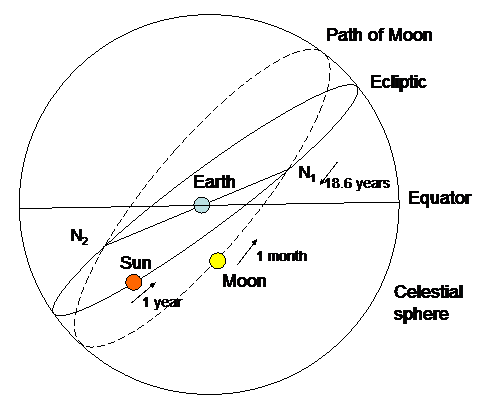
Apparent paths of the Sun and Moon on the celestial sphere (angles exaggerated for clarity)
Astrology practice has unfortunately been stuck in a charting system that acts as if the solar system and universe are flat. The flat wheel chart depicts the planets’ longitude positions only, leaving off their north and south positions, the declinations. That’s half the aspect picture. For me this is unacceptable. The added information of declinations changes the picture, changes the perception and interpretation of nearly every birth chart.
A Better moving picture of the planets
The Sun’s declination and the changes of seasons (equinoxes and solstices)
This more direct angle of the Sun upon areas north and south of the equator is what creates the seasons — not its east-west movement along the ecliptic (zodiac). In June and July the Sun’s position peaks in northern declination, creating summer in that hemisphere, and winter in the southern hemisphere. The reverse is true come December and January. When the Sun crosses 0° declination we have the equinoxes, which mark spring and autumn depending on what hemisphere you are in.
Notice the path of the Sun peaks northward in July just over the Tropic of Cancer at 23°27′ North at the summer solstice (summer in the northern hemisphere), and the path of the Sun dips lowest southward in December just over the Tropic of Capricorn at 23°27′ South at the winter solstice.

This is declination. Sun and planets’ paths move in a wave form north and south of the equatorial midline. When they near this area of 23° north or south they are considered in extreme declination (where their movement north/south slows down).
Pluto’s Declination off the ecliptic

Orbit of Pluto by Todd K. Timberlake, courtesy Wikipedia
When Pluto arrives at 0° Aries it is at about 15.5° South declination. It doesn’t hit the celestial equator +/- 0° until it is in early-mid-Taurus (about 10-13° Taurus). When Pluto passed into Libra in October 1971 it was at 15.5° North declination. It didn’t hit the celestial equator again until it was in early-mid-Scorpio (10-13° Scorpio). So you can see how Pluto lags about 1-1/2 signs behind other planets it in declination position.
Parallel Planets in Supposedly “Incompatible” Signs
Have you ever wondered why people of supposedly incompatible signs married and stayed together? The answer is partly found in the Parallel and Contra-parallel aspects of declination.
When planets are in signs of Northern declination (Aries through Virgo), there are possible parallel aspects created between planets in different signs, unlike conjunctions in longitude. The reverse is the same for Southern declination.

Declination along the ecliptic through the tropical sign changes
Here is an illustration to help you match up declination movement north and south through the zodiac. Notice that while moving through Gemini and Cancer planets/points are at their highest northern declination. Notice opposite this, Sagittarius and Capricorn are where planets/points his their lowest southern declination.
Planets in Aries can be parallel those in Virgo. If you’ve ever wondered why a Virgo and an Aries seem to get along together, get married and have children and stay together so compatibly, understand that their synastry may include parallel aspects between their charts that form bonds just as strongly as conjunctions do in longitude (flat wheel chart).
Taurus and Leo share about 12° to 20° North declination. Same story here. Yes, people whose charts show synastry squares can have points of great compatibility too.
This means declinations Often Create A Better Synastry Picture.
One person’s Sun-Venus conjunction in Taurus can be Parallel the others’ Sun/personal planets in Leo. This can allow for compatibility that conventional astrology says isn’t there. Parallels create fusion, unity in this fashion.
Very often when the flat wheel chart shows a lack of close aspects between mother and child’s charts (or lovers), there is often at least one significant Parallel or Contra-parallel in the declinations of their charts.
Declinations are so important for the whole astrological picture that I often look to them first.
Planetary parallels often allow fuller expression of both planets in mutually reinforcing or cooperative dynamics
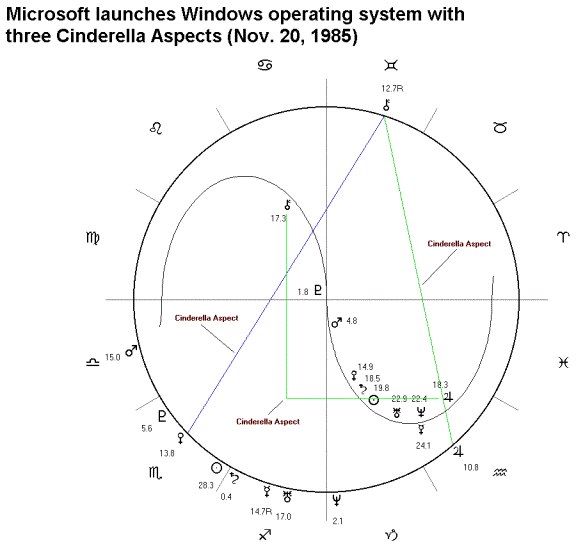
Notice Sun ☉ is in late Scorpio and parallel (1.6° orb) Jupiter ♃ in Aquarius. They are separated far enough that each body has plenty of room for its own beams to shine unobstructed. This can be more beneficial than many luminary/planetary combinations when they are conjunct in longitude (signs). When their lights merge in close conjunction, some planetary combinations really hamper one or both. Not so with these parallels, which show energies that are on the same wavelength so to speak.
This contrasts with Sun and Saturn’s conjunction and parallel. Sun is only about 2° from Saturn and they are only 1.4° apart in declination. This produces an entirely different and often more problematic dynamic of fusing of rays and energies than parallels in which the planets are wider apart in longitude.
Parallel aspects are often more beneficial aspects.
Celebrity Examples of Important Declinations (parallels and contra-parallels)
Jim Carrey’s birth chart not only has Mercury and Jupiter square the Ascendant, but because all three are right in the middle of fixed signs, they are in aspect in declination. Mercury & Jupiter are also parallel his Asc. This is a double shot of mental energy, jovial thinking, and antics.
Click image to see full size.
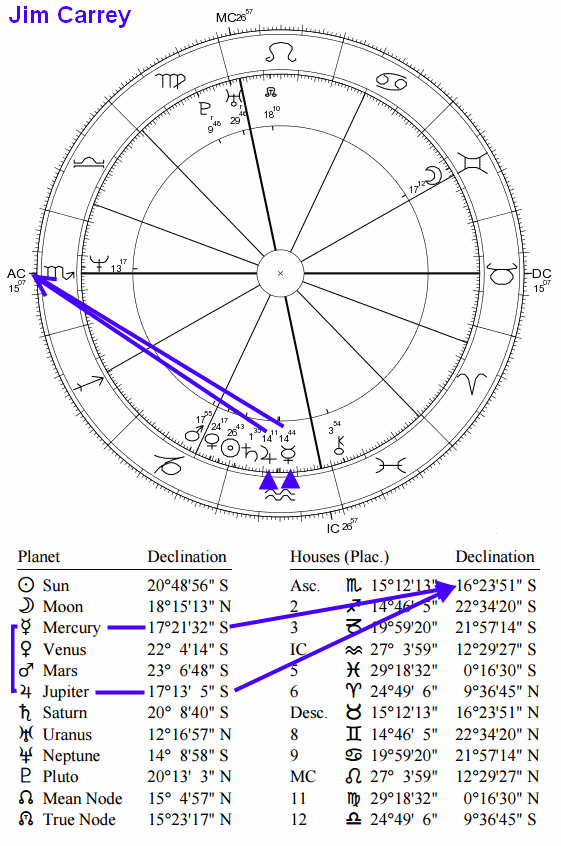
These illustrate very well the comedian’s verbal acuity, jovial nature, and his actor’s recall and big personality. These, added to the obvious Neptune conjunction to his Asc, show his birth potential for being a great actor. Carrey, not surprisingly, is also a big thinker, and has powered his career through optimism and a metaphysical creator’s approach to creating his life.
Another similar example, but with Pluto in the mix, is Robin Williams. Fellow comedians like Louie Anderson considered him the world’s greatest stand-up comedian. Here is Robin Williams’ data sheet showing declinations of Mercury parallel Asc and MC. Both Mercury and Pluto are conjunct the MC. In addition, note the parallels of Mars, Uranus, Pluto. Powerful bursts of energy.
Mercury is verbal agility, Mars-Uranus-Pluto is the potential of creative intensity that takes on a life of its own once it gets going.

Look at the transits for the date Mitt Romney pulled himself out of the 2016 U.S. presidential race (30 Jan 2015). Saturn [18S53] was parallel natal Moon [18S57] and Jupiter [18S31]. (This chart is unverified, and has an incorrect Asc figure).

New York real estate developer and socialite, Donald Trump has some pretty extreme declinations. Just take a look at this summary I slapped on top of the common chart for him.

 Here is the USA chart (using the Asc 21SAG04 as validated by John Willner). Look at Sun Parallel Venus, Mars, Jupiter (re dots) in high north declination. Sun is also Parallel Uranus (purple points). Sun, Venus, Mars, Jupiter also are contra-parallel Pluto. That’s a lot of power, charm, energy, and appeal in the declinations of the USA.
Out of Bounds Planets
Out of bounds (OOB) is when a planet passes outside the ecliptic, either northward or southward. I agree with Alice Portman’s assessment that out of bounds planets relate to the ability to function outside the box of conventional or expected behavior. This means a person who can go it alone in certain ways or take that planets’ energies a bit further than others. However, this concept of OOB has already been over-emphasized by students and astrologers new to declinations. That is because it is easy to identify and lends itself to simplistic (or over-dramatized) interpretation.
I don’t make too much of a planet being merely out of bounds. However, it definitely adds something to the overall strength of that planet.
Zero Degrees Declination: a Hidden Zero Point of Precession
Because precession is a backward movement of the earth’s axial alignment (wobble), it is implied in this declination cycle that as the earth moves from alignment with 0° Libra / 30° Virgo — or 0° declination moving slowly northward — that this could be a “zero point” for earth cycles of development.
Virgo implies impregnation and birth and the material supremacy of the iconic feminine (goddess) in this cycle with Libra implying a just, final balance between all opposites — integration.
The mistake of omitting declinations was — and still is — very widespread.
Declinations researchers & popularizers
K.T. Boehrer actually led the way in revitalizing the use of declinations in modern astrology. She authored Declinations, the hidden dimension. John Willner, author of The Powerful Declinations, did as well, but was less known. Some traditional Arabian astrologers used declination, but this was mostly lost when their ideas were borrowed by the Greeks (often incompletely learned) and transmitted westward.
In recent times the Magi Society has begun charting declinations superimposed upon the zodiacal chart along an S-curve (sine wave).
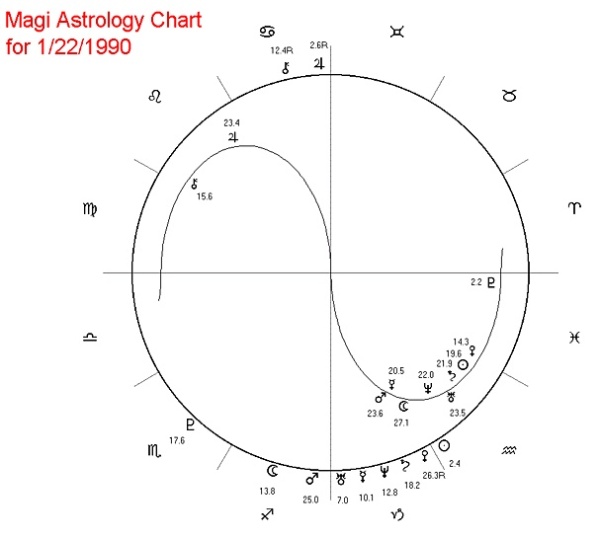
Declinations in Software
Some programs like SolarFire give a special sidebar aspectarian for declinations. Astrodienst will create a pdf document of planetary and house positions including declinations. (You have to find the declination aspects – parallels and contra-parallels – yourself). Even freeware Astrolog allows you to view declinations separately from zodiac position by going to the ‘Edit’ menu > ‘Enter command line’, and entering /sr. (Note the zodiac positions will be temporarily altered from correct until you again enter the command to reverse it.)
#astrology #declinations #aspects #parallelaspect #contraparallelaspect
 Kannon McAfee Natural Healing
very nicely done post.
I wrote you an email.
Thank you for this great article. It is difficult to find information on declination.
Sure thing. Thanks for stopping by 🙂
but why many great astrologers in past did not see declinations? surely,can’t be lack of knowledge,or calculating abilities. astonomical calculations are all known long back. so,why such important thing is missed? pl explain.
I don’t have any explanation, at least not a good one, for what other astrologers did. Maybe it has to do with charting systems and the human tendency for linear thinking (illustrations) about non-linear events.
near 23deg declination,a very low orb of 0deg-10 minutes is recommended(on sliding scale by some authors).in such case,1degree orb wont work being too wide for given declination? then what about 1deg-30min orb used by some at all declinations? what is the real standard? mainly,what is the logical,theoretical basis to decide orb@given declination? pl explain fully.
Functional orbs are defined by the planets involved, their energetic weight or size (luminaries, jupiter), or closeness to earth, and by the particular geometry of the aspect, not by their speed. We don’t reduce orb for planets in retrograde motion. Those aspects simply play out longer. The concept of orbs is from moeity of orbs, which recognizes the relation of the two bodies in aspect and what their individual orbs of influence are.
I have observed that the luminaries have functional orbs of influence in the natal chart at 1.5° or more (especially in relation to each other), that Moon and Jupiter have up to about 1.5°. Other planets, around 1°. Of course, this tightens very much in progressions to a maximum of 0°05′ (five minutes arc), the Moon being the only possible exception to that.
I am glad that you posted on Noel Tyl’s web site about the financial situation and gave a link to your website. I personally have uranus/pluto parallel which many people of my age but uranus/pluto is also contra-parallel my ascendent
Thanks for stopping by Amy 🙂
Hi Kannon: Stacy here from NTF. Started a thread about declinations in case you care to comment (you are “the Guy”, after all). Am sure your knowledge could help us all! –thanx!
Thank you Stacy. I’ll check it out soon.
Pingback: About Rectification | Kannon McAfee - the declinations guy
Thanks for this subject. I’ve made the mistake of practically ignoring declinations. More honestly, it feels like the heavens are just piling on since my Mars is already in detriment and retrograde and opposite my Sun and square my Jupiter. My Mars contraparallel 00°00′ is more than just a cherry on top. I’ve been wondering how such a “weak” Mars could lead to a remarkably chiseled physique and fleet feet, as 51 years of age approaches.
Thank for stopping by and commenting, jomotion. I also look at declinations as adding to our windows of opportunity in transits and progressions. More challenges, maybe, but also more opportunities.
Thanks for this subject. I’ve made the mistake of practically ignoring declinations. More honestly, it feels like the heavens are just piling on since my Mars is already in detriment and retrograde and opposite my Sun and square my Jupiter. My Mars contraparallel Ascendant 00°00′ is more than just a cherry on top. I’ve been wondering how such a “weak” Mars could lead to a remarkably chiseled physique and fleet feet, as 51 years of age approaches.
Many thanks for this. To be honest, I got confused with my natal chart interpretations on conventional astrology especially my sun, ascendant and dominant element because it’s a far cry from who I am and my life. My sun conjunct asc in aries and dominant element is fire with some earth and while its true that I’m a bit brave, down to earth, frugal, practical, stubborn, stingy, introverted and struggling with empathy (water and air are both very weak in my chart) but I’m anything but energetic, impulsive, confident, outgoing, loud which I’m “supposed to be” according to conventional astrology. I feel more like I’m earth dominant than fire. But upon seeing my planetary delineations in my chart, everything makes sense to me now. My chart is fire heavy but all my fiery planets are heavily aspected by my earth planets and MC. I do have sun conjunct asc in aries but those two are parallel with my earth saturn which explains my serious outlook in life plus my fiery leo mars have an out of sign conjunction with my virgo jupiter and at the same time parallels my taurus chiron.
Thanks for stopping by. Check out my Rising Signs page. Read the descriptions for Taurus rising and Pisces rising. It is unlikely that if you are an introvert you actually have Sun conjunct Asc in Aries. The Asc degree suggested by the recorded time of birth is correct far less often than you would assume.
Good article and agreed that declinations should be looked at more. When first learning astrology (mainstream, pop, overly sign focused forms), I was always confused why I related a lot more to the Signs Aquarius and Pisces in some ways than to Capricorn.
First Planetary strengths filled in some of the picture, Jupiter closest to Ascendant and still technically in the 1st House and strongly aspected (including to the ruler of the Ascendant, ruler of the Nadir and 9th House, very close one to MC and to the ruler of the Sign Jupiter is in),
and Angular Uranus and strongly aspected.
But the Neptune puzzle didn’t really start to make sense (as I felt fairly attuned to same), until I considered declinations. Some Neptune attunement would be shown via trine to Ascendant from the 5th, and my closest aspect is a Venus sextile to Neptune, with Venus ruling Moon and MC and being in the 7th (so a sensitive, amplified point of receptivity), and major aspect to the ruler of my Sun Sign which is also conjunct the Moon. But something was still missing.
Turned out, my Sun, the ruler of the Asc. was parallel (and semi-sextile) Neptune. One of only a couple declination aspects there was. Pisces S. Node and the regular Neptune aspects help to contribute but these weren’t quite enough.
I would live in the ocean if it were possible (and lived by the ocean for a few years and highly enjoyed it, spent MANY days down at the harbor and rocks swimming or just communing with the ocean, and also fished a lot since my family was poor). Almost always been a mystic, came in with hyper empathy to the point of painfulness as a younger child, high imagination, high psychic sensitivity (though strong Jupiter, strong Uranus, strong Capricorn, angular Aqua Venus, and Pisces S. Node also help to indicate same).
Pingback: US in Crisis – the Astrology | Soul Stars Astrology
Hi you have a fine website It was very easy to post it’s nice
Thank you, Ethan. And thank you for stopping by.
excellent article & illuminating answers. A doubt remains.
say, conventional horoscp-analysis shows problems due to afflictions to a planet x. but same x in declination has within 1degree parallel of benefic jupiter who is as strong as the affliction.
will it remove problems in X’s significations completely? or, to what approx % extent will it remove the problems? thanks. regards.
No, beneficial aspects by a planet in declination do not wipe out the challenging aspect(s) in longitude. All aspects are still there. It is a counter-balancing factor. The amount of influence each has depends on how close the aspects are — and on your intention to create better balance. The birth horoscope is just a starting place. Free will used consciously is the real power.
thank you for a prompt reply. however, want to know WHAT IS THE MAX %BY WHICH the Benefic
aspect in parallel declination will reduce the adverse effects of challenging aspect in longitude?
assume all other things being equal–i.e.strengths of all aspects, their closeness within 1degree,use of free will to improve(or its absence) etc.
thus comparative % effectiveness of declination parallel against adverse aspect in longitude is needed in apprx QUANTITATIVE terms, based on your valued experience. It can be even heuristic estimate by experience–which I want as general guidance.
thanks.regards.
There is no way to even approach answering that in this context not having the full birth chart before me. Experienced eyes on the chart directly can make such assessments in route to a full birth chart interpretation. No amount of experience can answer such a question blindly without seeing the actual chart.
And there is no aphorism or experience that can reduce such an aspect comparison to a percentage as you are requesting. Besides, both aspects you’ve mentioned will have their FULL effect. The counterbalancing force of Jupiter’s declination aspect depends upon the use of FREE WILL, your intention to maximize the good found in living towards mutual benefit with others. The birth chart is a starting place, not a determiner of outcomes.
I am currently studying astrology online at a reputable school and they assigned readings on declination but I really did not get it until reading your wonderful article! Thank you so much!
Thank you for reading and for the positive feedback.
What if each persons Moon declination is almost exact yet they were born on opposite sides of the world. I can find no interpretation for it. Is it possible or relevant ? ?
What matters in the synastry is the parallel or contraparallel aspect, not location of birth. Two people’s Moons in parallel show emotional resonance, a basis for mutual understanding no matter if the Moons are in different signs.
I find wealth of info in your article & answers. A small doubt here.
At 2 degree declinational-orb, can we still have mutual influences of concerned planets–but of half the power of the standard 1degee decli-orb ?? kindly clarify. thanks. regards.
Thank you for reading my articles.
As to orbs for declinations in the natal chart, there is some room for defining the outlying edge of these aspects. What I prefer to do is state what I am confident about rather than take an inclusive view that stretches the orbs. I want positive evidence to stretch the orb from 1°. So I start from 1° and what I have found is that the luminaries can be given orbs to all other planets a bit more than that. Perhaps Jupiter too. So if Sun or Moon is within say 1.3° or so of exact parallel or contra-parallel it can be seen in aspect. In my view currently, only the luminaries in parallel or contra-parallel with each other could be given a 2° orb.
The only place where there is question in my mind is with planets in P or CP to Asc or MC, specifically loka planets. And I’m starting to see evidence that 1.5-2° could be possible as a workable orb. That could change the framework for planet-to-planet orbs. I just need more specific chart scenarios to give me greater clarity.
Contrary to the opinions of some on parallels and contra-parallels the orbs should not be tightened when at the extremes of declination (22°+). If anything they can be loosened a bit. It is when the planets are much closer to the celestial equator (0°) that we may need to tighten the orb.
I wish I could be more definitive, but that is what I use at this time. The thing to do is if you know you have certain qualities of two planetary energies in aspect, say Mercury with Mars and there is no longitude aspect, but there is a wide-ish parallel or contra-parallel between them then count the aspect. If you think you’ve got such a scenario, then email me and let’s get our heads together on it.
I do not understand how you have an illustration showing Asc and Desc at 0 (zero) declination. My table of declinations do not have this. The declinations for these angles for the tables you show for Jim Carrey and Robin Williams do not have this.
The chart image above showing AC 0° Libra is for the purpose of illustrating the declinations of the signs, 0° (south) because that is the declination for 0°00′ Libra. Same for 0° Aries as the DC in that chart (0° north). It is not the Asc or DC that matters, but the declinations of the signs. I probably should erase AC/DC, MC/IC to avoid confusion on that point.
When you go down to the chart for Jim Carrey you see that the declinations of the Asc change according to the sign. 15° Scorpio always has its declination at 16° south, 12° Scorpio always at 15° south. Double check the charts or tables you are using.
Your article was very readable and easy to understand! I thought the world of astrology is wide. I would like to ask you about Orb.
In my birth chart, Mars and Pluto are contra-parallel with an orb of about 1.4 degrees. Is it okay to consider this as contra-parallel?
Mars 20º41’43 “N
Pluto 21º26’45 “S
First, you’ll need to use the topocentric positions to get an accurate positioning of the Moon, which can change it by as much as 1° in longitude and around half that much sometimes in declination. So always use the topocentric position which counteracts the parallax effect of the Moon since it is so close to Earth. This means its position is measured from the birth location rather than from the center of the Earth as the usual formula for Moon’s position does. Assuming your Asc is basically accurate (within a few degrees), that corrected position of the Moon will then allow you to see if it is in range of contra-parallel to Pluto. I’d say because the Moon is involved there’s a bit more leeway, but because Pluto is the furthest outer planet we’re probably talking not much over 1°.
Thank you for the informative article.
I wonder if I can ask you about parallels in synastry.
I’m currently in a situation with someone where we have an exact parallel between Chiron and the north node. However, they are not in the same sign and there no aspect between the two in longitude. An astrologer explained to me that if the two conditions above are not met then the parallel will not be felt. Even if its exact. Would you agree with this?
I can’t help but worry because I had a look through declinations in previous relationships as a point of reference and found the parallel between my Chiron and the other persons north node in my most excruciatingly painful relationship. This was heartbreak that I couldn’t even imagine, and the effects of which lasted for many years after the relationship ended. There was no connection between Chiron and the north node in longitude, however they were both in the same sign.
It’s amazing to me that without looking at the declinations, the severity of that connection might have been missed altogether.
No, I do not agree with that astrologer who clearly has not studied declinations closely enough. Whether the synastry parallel between Chiron and N.Node is active depends mostly on the orb. It needs to be pretty tight, definitely no more than 1°. It is entirely irrelevant if they are in different signs as aspects are geometry, and that is not sign dependent. And it is entirely irrelevant whether they are in any aspect in longitude.
A parallel aspect is milder on average than a conjunction (depending on how near exact it is), but a Chiron aspect is even less pronounced than those with planets. So it certainly is no cause for any worry. Understand that your painful experience in the prior relationship was not due to Chiron solely as it is a minor factor. Planets are the most important factors and I can guarantee you I could point out the stronger factors in that synastry were I to look at it.
Don’t mark it up to one aspect, especially not Chiron. Chiron is not “wounder”, but healer. However, with Chiron factors occurring in more of your relationships it is very probably that you have things to learn in your course of soul development related to healing and caring for yourself in the context of a relationship.
Thank you so much for your beautiful explanation. I really appreciate it. You are certainly right about my having to learn healing through these different experiences, as Chiron is definitely a reoccurring theme for me.
Chiron is usually one of the first things I check in synastry (even though I’m still learning) because in my natal chart I have an exact Yod (with Chiron at the apex) so when I discovered the parallel in my previous relationship I thought that the reason I felt so much pain was because that parallel triggered my yod.
There were mutual Neptune and Pluto aspects to personal planets going on there too so it’s impossible for me to say.
In this new relationship, the parallel between Chiron and the north node has an orb of 0 degrees exact. Would you estimate that this would still be less pronounced even if the chart holder has a strong Chiron?
It’s hard to say. I’d have to see your chart and/or the synastry to comment further. I’m in reddit astrology forums sometimes. If you want to post a thread there and tag me I will comment.
I’m also in the Lindaland (Linda Goodman) forum often.
Thats really generous thank you. If I create a post on lindaland do I just provide a link to the chart on astro.com?
How do I tag you in it?
Thanks
No, the link to the chart image will have to be stored elsewhere online, like photobucket, or a blog site. The image will expire quickly on your lindaland post and show nothing. You can’t tag me there per se, but you could name me in the subject of the post, like @Kannon
Hi Kannon
Thank you so much for the direction. I’ve saved the images online and created a post on lindaland with the links, and added your name to the subject box.
Hopefully you come across it.
Thanks again for all your help
Hello Kannon… I’ve just finished reading both your article and all the many response/replies that followed and I must say how very impressed I am by your ability to communicate… there is a sort of – I’m gonna say – kindness that permeates your words.
I began my relationship with astrology in 1964 and have been learning ever since. What I have just read from you is the most I have ever learned (well, read… it certainly hasn’t sunk in yet) on this subject. I have copied the link and will, no doubt, be reading it numerous times.
Thank you so much for being a gentle intelligence in the world.
What a very nice thing to say, and thank you very much. It’s always nice to know that I’m getting across what I want to say about declinations and things astrological.
(1)a planet is combust by longitude 5°away from sun,in conjunction.
But is at 2°or more declination orb-distance from sun.
Is it still having combustion effects,low strength etc.?
(2)or,a planet conjunct sun is not combust; but @1°declination orb-distance from it. Is it still having combustion effects i.e. low strength etc?
I don’t deal in old worn out terms like “combust.” The Sun does not ‘weaken’ anything. It is the energy principle itself, but tends to dominate (with will power) the way in which the other planet is expressed. But yes, the first situation is still a conjunction.
I have 5 planets in 9th house: jupiter and neptune conjuct mercury, that conjunct sun and moon. between sun and neptune there are almost 13°, so they’re not conjunct, but i feel that neptune a lot…, and i always thought that mercury was the “bridge” between the various energies…. Now I’ve discovered that all these planets (except moon 26°) and uranus are at 22°, So… Thanks for the interesting explanation! 😊
Glad the article helped explain something in your chart. Many planets near the extremes of south declination (in Sagittarius & Capricorn) can be in parallel aspect. 22° is in that area where planets slow down quite a bit in their south declination travel before they start going north again.
Hi Kannon,
Have been aware of you for many years in light of Spiritual Birth Astrology and Bickum training after Willner’s passing. Found this page on declinations after reviewing the “INCARN “Birth of the U.S.A.” data left on the old sbastro.com site. Noticed a number of algorithem chosen times which DID NOT HAVE a Cayce sojourning planet crossing the MC and wondered if this had to do with declinations or some other specific and sensitive aspect(s)? Were these special circumstances something you were given before all of Willner’s work (and Fred’s familiarity) “went dark”. Working on my family charts and would greatly appreciate whatever you can share on the missing non-MC potential soul insertion points.
Many thanks for any help!
Hi Steve and thanks for your comment.
I’m not sure how to answer your question other than to say that a planet can be parallel the MC even when it is nowhere near a conjunction. The sojourn planets you mention are referred to in traditional Indian (Vedic) astrology as loka planets or planetary lokas. They usually don’t align with the MC. It is confusing since Cayce often did not use recognizable astrological terms. Have you read my page on the US chart? Maybe it can answer the question. (My assessment does not match what Willner/Bickum did with it.) https://kannonmcafee.wordpress.com/2019/03/28/usa-birth-chart-a-rectification-illustration/
Otherwise, it may take a string of emails to suss out what you’re looking for or what will help you get the results you’re seeking.
Many thanks for your quick response and suggestion to look at using MC parallels.
Separately, was not expecting to hear that you arrived at Spiritual Birth Astrology through Vedic traditions. But thank-you for bringing up Indian Astrology…will definitely be looking into planetary lokas.
As for me, I was attracted to John Willner’s work for the very reason that he relied heavily on the astrological information coming from Edgar Cayce’s life readings. The Willner books I read “…Astrological Revelations, and “The Perfect Horoscope…” basically promoted his work as the modern and practical astrological application of Cayce’s words. I had grown disenchanted with natal astrology using hospital womb exit/breath times. Too often the chart results just didn’t make sense. Although hard to understand, Cayce nonetheless, for me, made the mechanics and process clear. As you know (and I mention here as a very simplistic explanation for anyone unfamiliar but reading this post) while in trance Edgar Cayce brought forth information (from Akashic Records) that considered the existence of reincarnation to be a fact. If true, this concept makes our current physical existence (current incarnation of our soul) to be but one of a series of perhaps many lives we may have to live in order to grow spiritually (I’ll skip any discussion of the higher purpose for this path as defined by Cayce). Here’s where it gets interesting for astrology: in-between physical lives our soul “sojourns” to (…think travels to and inhabits) the different planets, one at a time, and some stars, to learn the lessons of that planetary “plane”. These lessons loosely correspond to what we have recognized here on the Earth to be each planet’s energies, meanings and archetypes. After a selection process (which our soul is involved in) the decision is made to come back to life in the material world, and into a new incarnation structured to make our soul put its planetary learning to work. Specifically, Cayce indicated that the soul enters the body from directly overhead (i.e. coming down from the midheaven). I have had much success, rotating the chart from midnight to the midnight for a given day in order to find charts that make sense. This rotation is done by testing successive planets at the MC. Your “Birth of the U.S.A.” chart is a great case in point. [By the way, thank you for that chart! It is and impressive piece of work and with its extensive historical and transit analysis and rectifications.] With the U.S.A. chart, when you turn it to Uranus at or around the midheaven, everything falls into place…it becomes an interpretive “lock”.
SITUATION (09/29/1981): I have a son-in-law born with all planets within ~120 degrees and therefore only an 8- hour window within which to identify “the most fitting” planet crossing the midheaven. This “tight” period is aggravated by the fact that he has an early morning birthtime (5:15 AM) as the starting point for chart rotation. Further, it takes ten hours of rotation (five hours into the prior day) before any major planet comes near the MC. Numerologically, moving into the prior day creates a relative mismatch with what I believe to be main themes in his life. Cayce indicated spiritual birthtimes to be “typically” in the range of an hour to 1.5 hours ahead of standard hospital birthtimes — so ten hours for the first planet crossing is already an unlikely stretch. With your input above, I now intend to incorporate MC parallels or perhaps other meaningful astrological bodies (e.g. non-Pluto dwarfs, centaur asteroids). Right now Chiron has potential to fill the bill in my son-in-law’s chart. I don’t have much familiarity with these smaller orbital bodies but will look into their use and likely give them more consideration in the future.
All the best and many thanks for your help (Parallels!)
Steve,
I didn’t arrive at it via Vedic astrology. I’ve only delved into Indian astrology in the last few years as a later addition to what I learn from Willner’s work. Willner’s book The Rising Sign Problem (imperfect though it is) is the most practical guide for this work.
Not everyone has a planet at the Midheaven in their birth chart. So beware of force-fitting such a thing. Many birth charts have a planet or planets in other aspect relations to the MC.
Your son-in-law’s 5:15 AM delivery time indicates his correct Asc will be located between midnight and 6 AM. Look at the loka planets for clues.
Sir; mercury fully sqared by mars (who in turn afflicted by saturn– thus Saturn too afflictng mercury through Mars.). If mercury,Mars are within 1° Parallel,then will such Saturn affliction via Mars be further intensified onto mercury?? Assume Saturn Mars are far off in declination
Sorry, but I am no longer practicing astrology indefinitely. These web pages are kept here for your reading and study.
Pls, whats your view on the relationship between sun,Mercury,mars and the sixth house in the chart. Also Jupiter/Moon and the 12th house longitudinally and in declination (11/11/1976). Thanks
Sorry, but I am no longer practicing astrology. I have left the astrology content here on this site for reference only.
Thanks so much for your response